Dark Souls D&D: part 3, economy of combat
This is a hack of 5th edition D&D, so where is the 5e D&D? In a round of combat the players can take one action, take one bonus action (if something grants it), move, and take one free object interaction, plus one reaction that can be spent at any point during the round. Here it is! There's no Stamina in this hack, just the economy of combat.
I created a new category of moves that exists outside of this order, but also lives within it: Defensive Combat Actions
Block, Dodge, and Parry are all categorized as Defensive Combat Actions and these have special rules which conduct how they can be used. Defensive Combat Actions can be used as a Reaction, a Bonus Action, and a Free Action. You can use three Defensive Combat Actions in a single round and they can be all the same action (Block three times), all different actions (Block as a Reaction then Dodge as a Bonus Action then Parry as a Free Action) or a mix of actions (Block once then Dodge twice). For all Defensive Combat Actions, the defender wins ties.
Block and Dodge can be declared after an attack roll is made but only if it hits and they MUST be declared before damage is rolled for an attack. Parry MUST be declared before an attack roll is made.
Block: There is no roll required to Block. Your Shield reduces incoming damage by the amount of its Block rating. Some damage types can ignore Block so be careful when and where you use it. You can Block twice per round without risk, once as a Reaction and again with a Bonus action. If you attempt to Block a third time in the same round, you must use a Free action and risk being Staggered. Roll 1d20 + Block rating + Constitution modifier. If your roll equals or exceeds the attacker's Attack roll, you successfully Block (reduce damage by Block rating). If your roll is less than the Attack roll, the Block fails: your shield reduces zero damage and you are Staggered. For Example: A Fighter with a Buckler (Block 7) and Constitution 13 (+1) faces an attack roll of 16. He uses his Free action and rolls 1d20+8. He needs to roll 8+ to succeed (8+8=16, defender wins ties). Anything less and he takes damage and is Staggered.
A weapon can be used to Block, but you must be wielding it two-handed to do so. A weapon’s Physical Damage Block rating is equal to their maximum damage dice divided in half, rounded down. Example: A Zweihander is Block 6 (2d6+1 = 13, divided by 2 = 6.5 or 6) and a Rapier would be 4 (1d8 = 8, divided by 2 = 4).
Dodge: Your Dodge roll must equal or exceed the Attack roll that is intended to be Dodged, if successful your character moves away from the attacker (1 square or 5 feet), their attack misses and you take no damage. A successful Dodge allows your next attack THAT ROUND to have Advantage - timing matters. On a failed roll the Attack hits.
Parry: You must have a shield or weapon in your offhand. Make a Parry roll with your offhand item; some shields and weapons provide Parry bonuses. The attacker must roll higher than your roll or else they are Staggered and vulnerable to a Riposte. Defenders always win ties, so rolling a natural 20 on a Parry means the attack is automatically parried regardless of the attacker's roll. If the attack roll exceeds the Parry roll, the Parry fails and the attack hits. When a Parry fails, the attacker’s damage dice are rolled twice and they keep the best result.
Example: Gareth declares a Parry and rolls a 16. His attacker, Zhor, also rolls a 16. Gareth is the defender, so he wins the tie and parries Zhor, who is now open to a Riposte. In the next round, Gareth declares a Parry but rolls a 2; Zhor will now hit him on a roll of 3 or higher. Zhor rolls a 4, Gareth's Parry fails, and Zhor hits him even though normally that roll would have missed. Some attacks cannot be parried; the GM is under no obligation to reveal if an attack can be parried before you attempt it.
Essentially, the Parry roll resets what is required to hit your character, but it comes with the risk of taking extra damage because the reward for success is being able to Riposte your opponent.
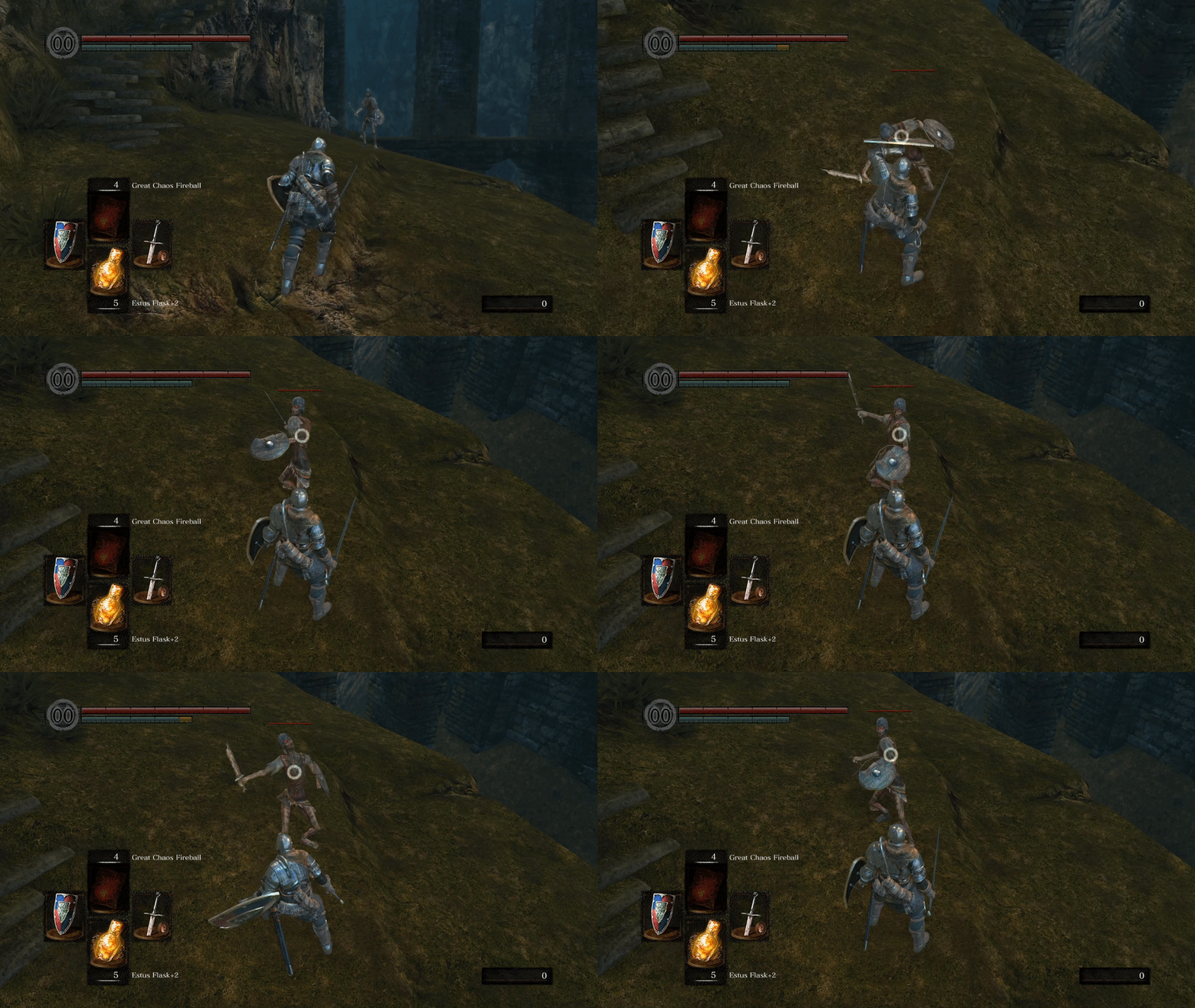 Stagger: Stagger is a debilitating condition that can happen if your character overexerts themself or if they are caught in an overwhelming attack. When you are Staggered you cannot Move or take actions, and all rolls have Disadvantage. Recovery automatically happens at the end of the round, unless a special condition keeps the character Staggered. While a character is Staggered they can be attacked with a Riposte.
Shield Bash: Some shields can be used to Bash opponents. These attacks typically do not cause a lot of damage but they have the potential to Stagger an opponent and leave them vulnerable to a Riposte, Large Shields are much more effective at this than Medium or Small Shields where it is nearly impossible.
Shield Bash replaces Block as a Defensive Combat Action. You cannot Block and Shield Bash in the same round, and Shield Bash cannot be used as a Reaction or Free action.
Shield Bash is a close quarters attack. Make an attack roll as normal. On a hit, roll the shield's damage die. The target takes that much damage, and the damage roll also serves as the Stagger rating. The target must roll 1d6 + Poise; if the Stagger rating exceeds their roll, they are Staggered and vulnerable to a Riposte. Make a Poise check against the Stagger rating even if some or all of the damage from the Bash is reduced by armor.
Backstab: A Backstab is a special Attack that deals more damage than a normal Attack by striking an unsuspecting or surprised enemy from behind. No Attack roll is necessary as long as the opponent is unaware of their attacker. Damage is rolled as if the character made a Critical hit (double damage dice then apply modifiers). If a weapon has the Crit trait, then the number attached is added as a damage bonus to the modifiers. For example??: Anora the Pyromancer has a +2 bonus to damage while wielding a dagger (1d4+1 DEX2 damage). If she can Backstab someone she will inflict 2d4+3 damage. Nym the Hunter has a +3 damage bonus with his parrying dagger (1d6 damage, Crit 6) so when he backstabs he will inflict 2d6+9 damage.
Riposte: A Riposte is a special Attack that is made with a Free action. You must either be standing, or end your movement, next to an opponent who is Staggered. A Riposte does not require a roll to hit and inflicts maximum damage for the weapon used, no roll necessary, plus any Crit damage for the weapon. As a general rule of thumb, the character who inflicted the Stagger gets the first opportunity to Riposte a Staggered opponent. If they choose not to Riposte, then follow the order of initiative to determine who gets the next opportunity.